
The garden had always been Gerald Hoff's excuse to avoid his wife's book club. Every Saturday morning, while Miriam entertained three other women who dissected novels, Gerald pulled on his rubber boots and disappeared into the narrow strip of earth behind their semi-detached in Harrogate. He grew nothing remarkable — some courgettes, a few rows of runner beans, and mint that kept escaping its pot. But the digging itself was the point—the resistance of clay soil, the clean smell of turned earth, and the satisfying thud of the spade.
It was the third Saturday of October when the spade hit something that wasn't a stone. Gerald had learned to distinguish the sounds—the flat crack of flint, the dull thud of a buried root, the hollow clunk of an old clay pipe. This was none of those. It was a bright, almost musical ring that travelled up the handle into his palms, and it stopped him completely.
He crouched and worked the soil away with his fingers, the way he'd seen archaeologists do it on television. Six inches down, the dirt gave up a small oval object, dark with tarnish and compacted earth, hung on what appeared to be a chain so fine he nearly mistook it for a root filament. He wiped it on his trousers, held it up to the grey October light, and felt the first strange shiver of something he couldn't yet name…
Miriam held the necklace under the kitchen tap, rubbing gently with her thumb, and the tarnish reduced to reveal a dull gold lustre and the unmistakable shape of an oval pendant, roughly the size of a fifty-pence piece. On one face, a small inlaid stone — deep red, possibly garnet—surrounded by a border of tiny raised dots. On the reverse, markings that might have been letters, or might have been something older than letters.
"Take it to someone," Miriam said, setting it on the draining board.
On Monday, Gerald took it to Ackerman & Son on Parliament Street, the kind of shop that still had a bell above the door and velvet pads in the window. He'd bought Miriam's engagement ring there, twenty-six years earlier, from the father. Now it was the son — David Ackerman, fifties, half-moon glasses, the careful unhurried manner of a man who had handled other people's precious things his entire life.
Gerald set the pendant on the glass counter and said nothing, curious to see what a professional would make of it. David Ackerman picked it up. He turned it once. Then he set it down, removed his glasses, and looked at Gerald with an expression that was not quite what Gerald had expected—not the polite curiosity of a man assessing a trinket, but something considerably more guarded than that.
Where did you get this?" Ackerman asked. His voice was level, but there was a quality to the stillness that followed that made Gerald stand a little straighter. Gerald explained. Ackerman listened without interruption, which was itself unusual; in Gerald's experience, jewellers spoke constantly, filling silence with valuations and reassurances. Ackerman said nothing until Gerald had finished. Then he asked if he could take the pendant to the back. Gerald waited at the counter for nearly fifteen minutes. Through the half-open door, he could hear the faint tick of instruments being set down, the rustle of what might have been reference books. When Ackerman returned, he was carrying a jeweller's loupe and a sheet of paper on which he had written nothing.
The chain is eighteen-carat gold," he said, "which isn't particularly old or unusual. But the pendant is something different." He set the loupe on the counter. "The metalwork on the border—those raised dots—that's called granulation. A very specific technique. Some ancient artisans used it, and it was largely lost after the fall of Rome. It reappeared briefly in the early nineteenth century when there was a fashion for archaeological jewellery, largely driven by a Roman goldsmith named Castellani." He paused. "But this doesn't look like a Castellani reproduction. The granulation is too irregular. Done by hand, without modern tools."
Gerald looked at the pendant. "How old is it?" he asked.
Ackerman considered his answer with visible care. "That," he said, "is precisely what we may have to find out."
https://www.tips-and-tricks.co/various/gardennecklace/4/#:~:text=22%20Apr%2C%202026-,ADVERTISING,ADVERTISING,-%22I%20want%20to
"I want to be careful here," Ackerman said. "I'm a jeweller, not an archaeologist. I could be wrong. The piece could be a later imitation—there were fashions in the 1800s for this sort of thing, and some of the reproductions were extraordinarily good." He picked up the pendant again, tilting it under his bench lamp. "But if it isn't an imitation, and it has been sitting six inches beneath your garden in Harrogate for some considerable time, then it raises questions I'm not qualified to answer." Gerald asked what he should do.
"Don't sell it," Ackerman said immediately—and it was the speed of the answer that stayed with Gerald, walking back through town with the pendant in his coat pocket. A flat, immediate instruction, delivered with the gravity of a man who had seen something he did not wish to be responsible for mishandling.
Gerald was not a man who read significance into things. He had spent thirty years as a civil engineer. He believed in observable data, calculations, and the dull reliability of facts. But that evening, sitting at the kitchen table with the pendant under Miriam's reading lamp, he found himself affected by it in a way he couldn't rationalise. The craftsmanship was, even to his untrained eye, extraordinary. Each tiny granule in the border was perfectly spherical, no larger than a grain of sand, fixed to the surface with no visible solder. He'd looked up Castellani after leaving Ackerman's, and the reproduction jewellery from that period had a certain self-consciousness to it, the slightly-too-perfect quality of work made to impress. This was something else. It had an unguardedness, as if it had been made not to demonstrate skill, but simply because the maker knew no other way to work.
Miriam sat across from him, reading nothing, watching him. "You're going to follow this up," she said. It wasn't a question.
Gerald contacted the Yorkshire Museum the next morning. The finds liaison officer—a brisk, practical woman named Dr Sarah Okafor, agreed to see him within the week. When she arrived, she examined the pendant with the controlled focus of someone accustomed not to revealing what she was thinking until she was certain. Then she set it down, folded her hands, and told him that under the Treasure Act 1996, he was likely obliged to report the find.
“Why likely?" Gerald asked.
"That depends," she said, "on what it actually is."
What followed was six months of patience, which Gerald had, and bureaucratic uncertainty, which Miriam had less tolerance for. The pendant went to the government museum's portable antiquities team for analysis. A metallurgist, a classicist, and a specialist in pre-Roman Mediterranean trade objects were all, at various points, involved. Gerald received official letters in formal language that committed to very little.
But in March, Dr Okafor rang rather than wrote, and her voice had a different quality. The analysis had confirmed that the metal was consistent with Etruscan alloy compositions from roughly the fifth to the third centuries BC. The carnelian stone was of a type sourced from the eastern Mediterranean. The granulation technique matched examples held in Florence and the Vatican collections. A university epigrapher was assessing the symbols on the reverse, but preliminary indications suggested a dedication or ownership inscription—the kind placed on objects of personal significance.
"We're not calling it definitively Etruscan," she said carefully. "But the balance of evidence is strongly suggestive."
Gerald sat with this. Then he asked the question that had been circling since October. "How does an Etruscan pendant end up six inches under a garden in Harrogate?"
"That," Dr Okafor said, "is the part that interests us most. It isn't impossible—Roman legions moved objects extraordinary distances, and there was significant trade through what is now York. But six inches is very shallow for something this old to survive in agricultural soil. It may not have been there as long as it appears."
The epigrapher's report arrived in April—a twelve-page document from the university that Gerald read three times. The inscription on the reverse, translated with appropriate caveats, appeared to read: for Thania, beloved, who goes before. A mourning dedication. A piece made for grief. Something about that landed differently than everything else. The metallurgy, the trade routes, and the soil analysis were all interesting, the way a documentary was interesting. But Thania was a person. Someone had lost a person, and had given that loss a shape in gold and carnelian, and the shape had survived while the giver, the receiver, and the civilisation that produced them both had gone entirely.
Miriam read the report over his shoulder and said nothing for a long moment. "Someone buried it," she said eventually. "They didn't drop it. Six inches is deliberate."
Gerald had thought the same thing. Buried with care, not lost by accident. The chain had been folded neatly, not tangled as dropped jewellery tends to be. Someone had placed it in the ground on purpose, which raised the question of when, and why, and whether the ground in question had, at some much earlier point, been the site of something worth placing it beside. He rang Dr Okafor the next day. She had, she told him, already been in conversation with the North Yorkshire archaeology unit. There was the possibility of a supervised ground survey of the property, if Gerald and Miriam were willing. Gerald said he'd need to ask Miriam. Miriam, when asked, said yes immediately.
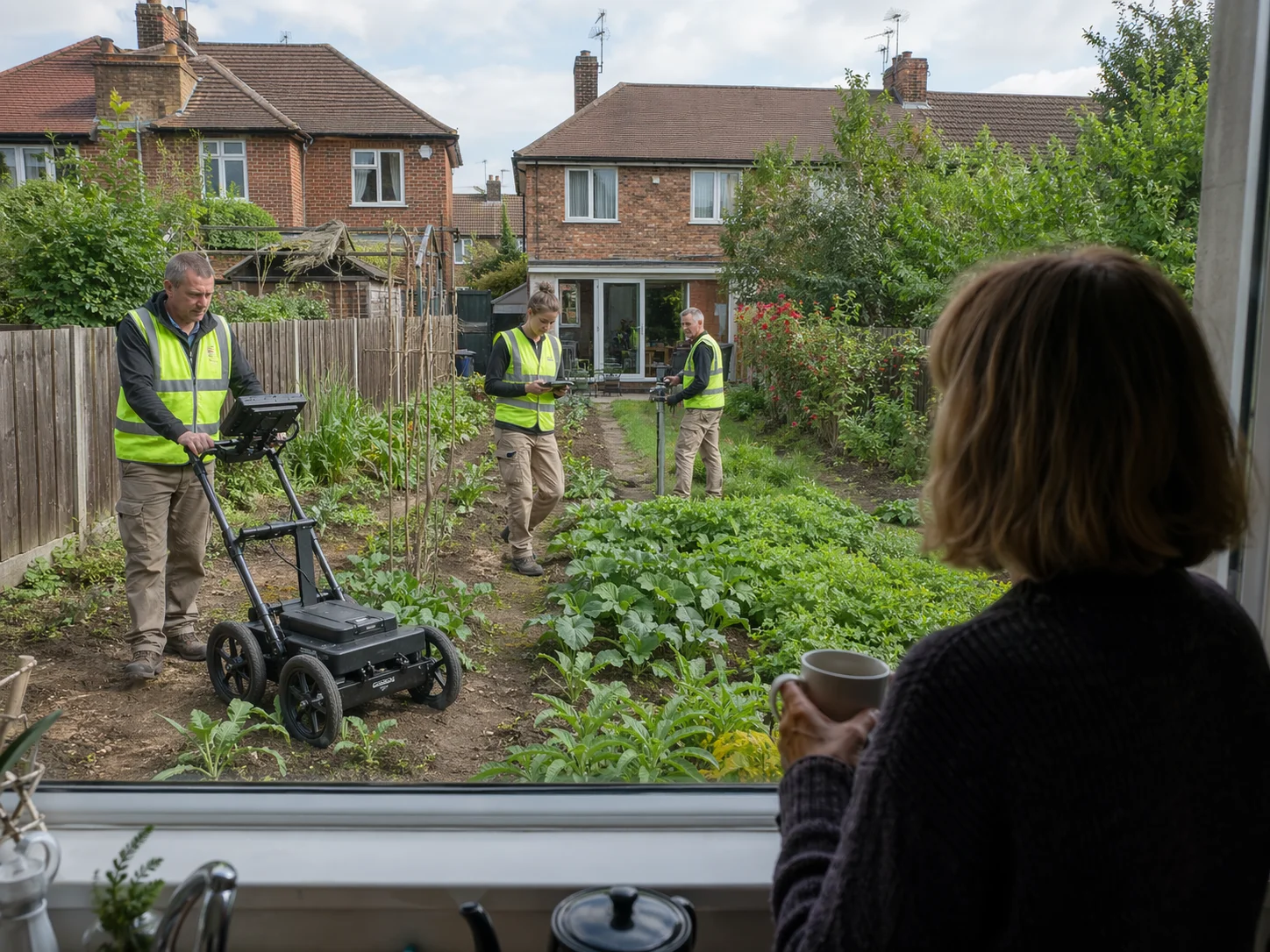
The survey took place over two weekends in June, conducted by a quiet, methodical team of four with ground-penetrating radar equipment and a manner that suggested they were trying hard not to get anyone's hopes up. Gerald served coffee and stayed out of their way, watching from the kitchen window as they moved the equipment in slow overlapping passes across his courgettes. On the second afternoon, they found something. A roughly circular area of soil disturbance approximately two metres across, at a depth of between forty and eighty centimetres, positioned toward the back of the garden. The kind of pattern that could indicate natural geological variation. Or, the team leader said carefully, the kind of pattern consistent with a deliberate burial or deposit of some age.
Gerald looked at the patch of ground, which looked identical to every other patch of ground. "What do we do now?" he asked.
"Now," the team leader said, "it becomes an excavation question, not a survey question. That's a different process, different permissions, different team."
The permissions took until October—almost exactly a year after the spade had struck the pendant. The excavation team had six people with hand tools and a methodology that made Gerald's engineering precision look reckless. They removed soil in horizontal layers of two centimetres, sieving every load. For three days, nothing. Then, on the fourth morning, Gerald arrived in the garden to find the lead archaeologist crouched at the base of the pit with her brush moving very carefully indeed.


0 commentaires:
Enregistrer un commentaire