
What you need to know:
- National says it will allocate $1.75 billion to start construction on Mill Road in Auckland - one of its Roads of National Significance - if it leads the next government.
- Te Pāti Māori says it’s putting its “money where its mouth is” by announcing a one-person party list for the election.
- The Green Party has announced a plan for intercity passenger rail services, if elected.
- ACT says it will do away with karakia and religious ceremonies being a condition of consents for homes or businesses, if it's part of the next government.
- Labour released its long-awaited fiscal plan, including an immediate pay rise to 65,000 care and support workers, costing $2.5b over four years.

Luxon temple visit
The National leader's next stop on Sunday was the Takanini Gurdwara Sri Kalgidhar Sahib Sikh Temple, a stop he makes every year - as have many prime ministers before him.
The temple is renowned throughout this part of South Auckland for its food parcels, and the Prime Minister and his entourage were greeted warmly, and with the hospitality that has seen it become one of Papakura’s designated Community Emergency Hubs.
Upon arrival, Luxon was welcomed with a rendition of the national anthem.
He was surrounded by people, with many trying to get a photo, while his team were trying to usher him inside, but Luxon was happy to chat, and happy to be steered in the wrong direction for a handshake and a selfie.
He made his way to a couple of stalls set up in the outside area, before being ushered inside. Requests for photos followed, his staff and diplomatic security (DPS) getting slightly more on edge, as one man with a microphone kept trying to get close to Luxon.
Inside, Luxon stopped along the way, greeting families and especially young people, very happy to take photos with new babies or older ladies standing back.
Again, his team tried desperately to create space around him for cameras to film and for Luxon to get to the back of the dining area to greet the cooks. At this point, RNZ overheard one DPS member specifically asking for the man with the microphone to be kept away.
From its recently renovated kitchen, the temple's community has served and delivered about 6000 meals and food parcels a week during times of greatest need.
In front of the kitchen, Luxon stopped for a lengthy chat, asking how many people they would cook for - at a Diwali event for example, it would be in the tens of thousands.
"It's incredible what you're doing," Luxon told them.
RNZ later asked the cooks whether they'd met with prime ministers before. Hardeep Singh confirmed he had - Jacinda Ardern, Sir John Key, even Helen Clark.
RNZ asked Singh what was on the menu on Sunday. He said snacks and bread products in the morning with a cup of tea.
Lunch consisted of two different vegetables, along with rice, yoghurt and chapati, and one sweet dish. After that, he said, "more, more stuff, more, more stuff".
His team again tried to usher him onward, DPS sticking close to Luxon. On his way out, the mum of nine-year-old Jasleen managed to snap a photo of her with the prime minister. Asked afterward by RNZ what that felt like, she said "a dream".
Heading upstairs, Luxon then spoke to those gathered in the prayer room above, acknowledging the community and their contributions.
After the visit, RNZ spoke to some of those still gathered outside, where National Party hoardings promising to fix the basics lined the street.
"Blue today, red tomorrow," one temple regular told RNZ, in a matter-of-fact, but not begrudging assessment of the inevitability of political visitors during election campaigns.
"It's good to see him," Guri told RNZ. "I think he's listening, but will he act?"
Asked what was most important to him, Guri, who's a teacher, replied "education".
"I worry we're slipping behind the rest of the world."
- Lillian Hanley, RNZ
Labour fiscal plan
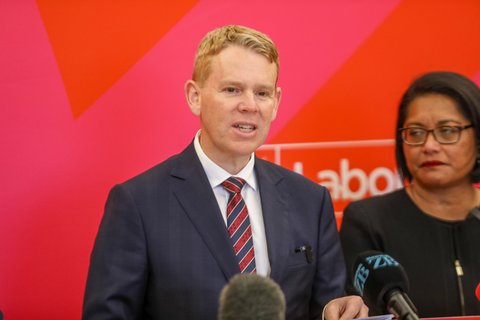
Labour has released its long-awaited fiscal plan, saying every promise it's made is "fully costed and paid for", despite not providing a cost for fully re-implementing the pay-equity legislation.
It does, however, promise an immediate pay rise to 65,000 care and support workers, costing $2.5 billion over four years, and Labour leader Chris Hipkins says there's "plenty of headroom" within the plan to pay for pay equity overall.
Finance spokesperson Barbara Edmonds said Labour would keep operating allowances at the $2.4 billion set by the coalition government in Budget 2026.
The party said it wouldn't rely on a larger operating allowance, stating new investment "must fit within these allowances, alongside cost pressures and other priorities".
"Our announced capital commitments fit comfortably within the $12 billion of future capital allowances," said Edmonds.
"We also have almost $10.5 billion of future operating allowances unallocated. We can deliver what we have promised without increasing those allowances."
Edmonds also said Labour would return the books to surplus in 2028/29 and bring net debt down below 20 percent of GDP "over time", maintaining it would use the OBEGAL measure, rather than the government's preferred OBEGALx measure.
"We can do that, because we have made better choices about where public money goes and will make every dollar work harder."
- Lillian Hanly, RNZ
Labour pay equity policy
Labour has promised to restore pay-equity legislation in its first 100 days, and give an immediate pay rise to 65,000 care and support workers.
Last year, the government overhauled the Equal Pay Act, retrospectively stripping nurses, teachers, carers and other female-dominated workforces of the right to pursue pay-equity claims under the existing law.
The controversial legislation stopped the 33 claims underway and raised the threshold for proving work had been historically undervalued.
Under a Labour government, from 1 January 2027, care and support workers would receive a pay rise of $4 an hour - making the average fulltime worker $8320 a year better off or $160 a week before tax.
Labour workplace relations and safety spokesperson Jan Tinetti said her party would not accept a system where work was undervalued, just because it was traditionally done by women.
“Care and support workers do some of the most important work in our communities and, overwhelmingly, they are women," she said.
“This immediate pay rise is real money for people who are paying the mortgage, the rent, the power bill and the grocery shop. It reflects their hard work and the hardship they’ve experienced these past three years under National."
The re-instated legislation would accommodate the work underway on the previous claims, Tinetti said.


0 commentaires:
Enregistrer un commentaire