
One of Mount Everest's frozen victims has finally had his identity confirmed, 30 years since the fatal climb.
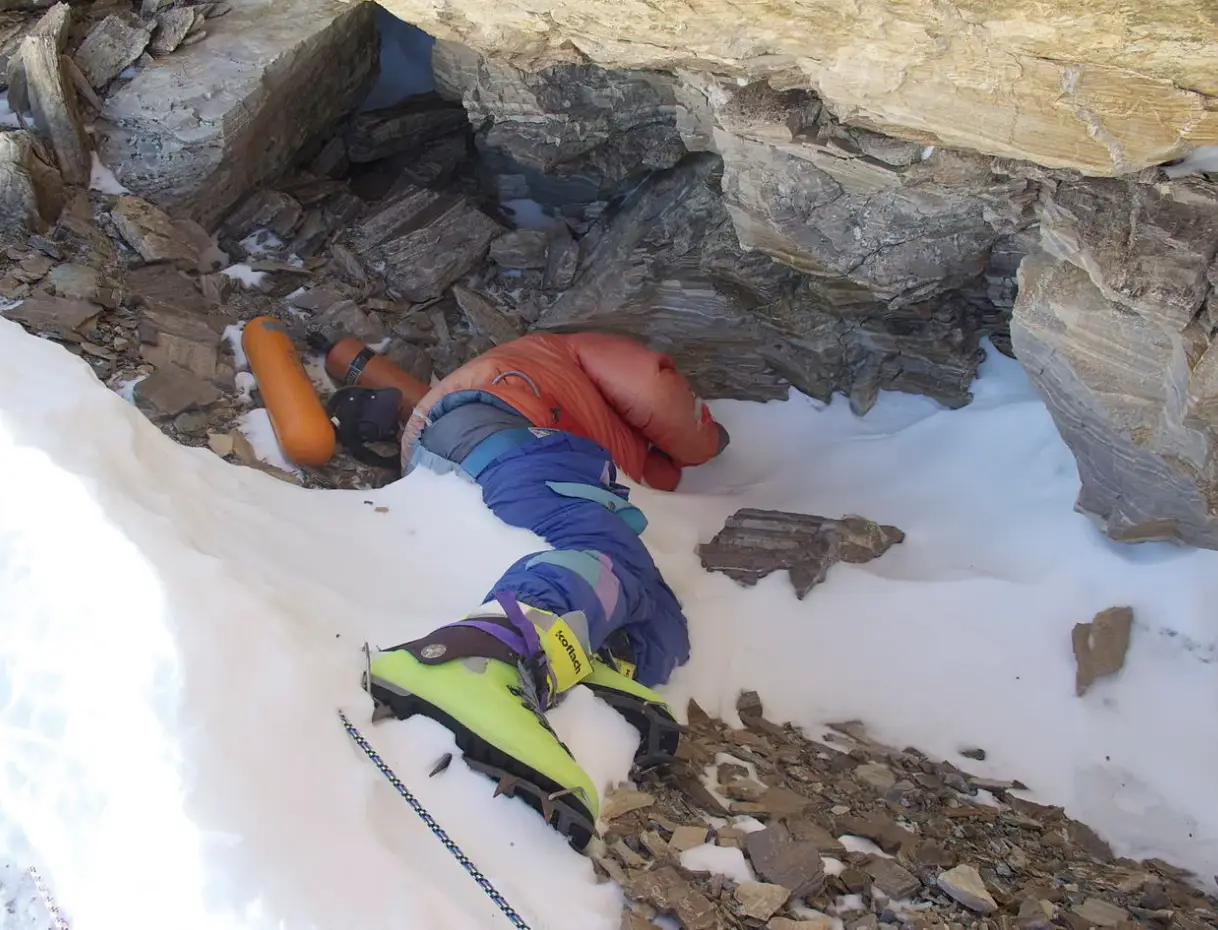
Since 1996, mountaineers scaling the tallest peak on Earth (which is believed to have claimed more than 340 lives since records of such things began) must come face-to-face with a body known as 'Green Boots'.
Our fallen adventurer is situated at least 26,246 feet up the colossal landmark and stands to this day as an eerie totem of its so-called 'Death Zone'
It was believed for a long time that this was the body of Indian climber Tsewang Paljor, a 28-year-old, yet the Indo-Tibetan Border Police now say otherwise.
This particular soul is actually Paljor's countryman, 47-year-old Dorje Morup.
Per The Sun, the ITBP recently identified Morup ahead of a push to recover his remains from the mountain.
A high-altitude rescue team is set to undergo this life-threatening recovery operation later this summer, in fact.
As for Morup's personal story, he was part of a six-man expedition attempting to summit Everest's north face on May 10, 1996.
Inevitably, the group encountered a monstrous blizzard near the very tip, leading to the half of them turning back.
Morup, Paljor and Tsewang Samanla continued their journey onwards before succumbing to the mountain a little while later.
Records show that this brave trio radioed their team leader around 3.45pm local time, reporting that they'd reached their prestigious destination.
Subsequent accounts indicate that poor visibility could've made it tricky to ascertain their exact location, though.
Soon enough, the three adventurers were being whipped by ferocious winds that reduced visibility to almost non-existent.
Below them, the others who'd bolted from the scene earlier allegedly saw two headlamps moving above the Second Step; this was to become the last-ever sighting of Morup, Paljor and Samanla alive.
As we can see in the image above, 'Green Boots' was nearing the foetal position when he passed away, sheltering in a little cave as Everest's natural artillery rained down on him.
The 'Death Zone' is named as such because it is a particular point on the mountain where oxygen is seriously scarce.
Meanwhile, the UK's first-ever deaf Everest climber Michael Woods reported in from the 'Death Zone' this year.
He wrote on social media: "There were moments during this expedition where I genuinely didn't know if I could make it, especially after being sick and struggling with energy, but somehow I found a way to keep fighting all the way to the top of the world.
"Standing on the summit of Mount Everest is something I'll never ever forget."
Picture this, you sit down at a pub quiz and you're asked to name the world's tallest mountain.
It's Mount Everest, right? Everybody knows that. But no, you're wrong, and the team of over 70s wins for the 382nd week in a row.
There are plenty of things we think we know about, but the reality is we learn new things every day. Life would be pretty boring if we knew everything already.
For example, travellers to Egypt would be forgiven for thinking that there are four sides to the pyramids of Giza, because anything more than four would be insane, right Jeremy? Wrong again.
Maybe you think you're an expert on something like Harry Potter, but only after 20 years of watching it do you realise the talented British actor who
Anyway, I'll put you out of your misery and explain exactly why Mount Everest technically isn't the tallest mountain, in an update which I'm sure is going to devastate gap year students across the world.
Everest's peak stands at an impressive 8,849m above the ocean, making it the piece of land at the highest altitude on Earth.
However, it is not the tallest mountain in the world when you consider that some of its competitors start below sea level.
Nobody tell Donald Trump, but America is actually home to the world's tallest mountain.
Maybe it's compensating for something?
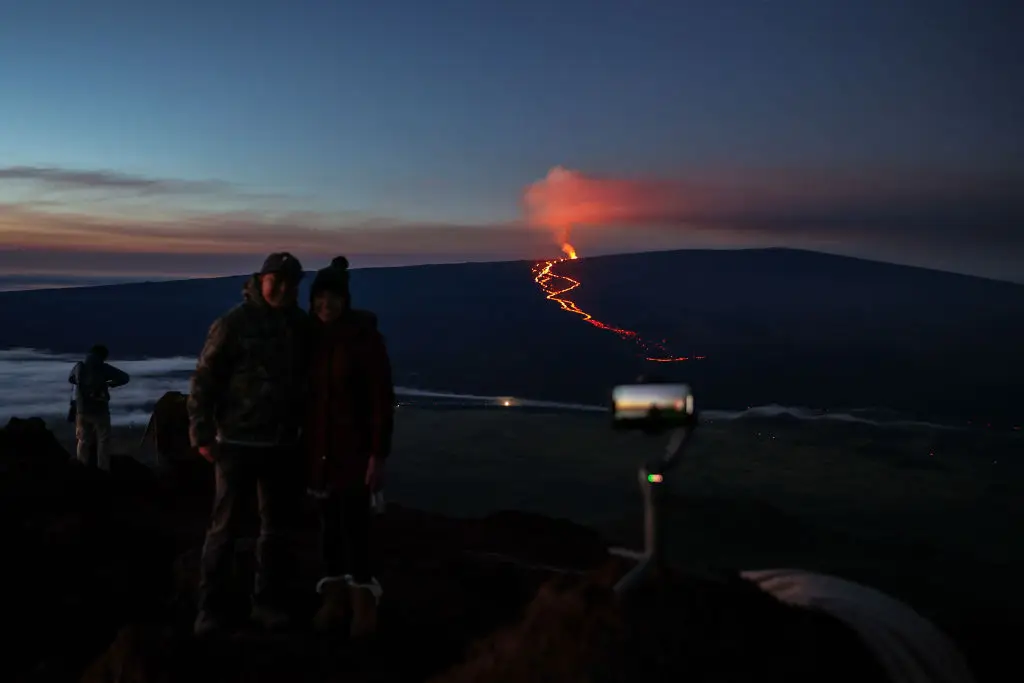
Mauna Kea, a long-dormant volcano in Hawaii, stands at a mammoth 10,205m (33481 feet) in height, which practically makes Mount Everest a short king by comparison.
The US state is clearly the place to be when it comes to absolutely gigantic natural features, as if you want to talk about the mountain with the greatest volume, then you also need to say goodbye to Nepal and aloha to Hawaii.
Mauna Loa is another active volcano which encompasses about 10,000 cubic miles (42,000 cubic kilometres), making it one of the biggest things on Earth.
If you want to get even more specific with your definitions, and perhaps you think the closest mountain to the sun should take the title, then you'll need to visit Ecuador to see Mount Chimborazo.
Due to Ecuador being located on the equator and the Earth not being perfectly spherical, the active volcano located just one mile south of the equator actually sticks out a little more than others, making it the closest to the sun.
So, the next time you're asked the question at a pub quiz, it might be safer to put four different answers to make sure you get the point, not that the team that is marking yours will appreciate it.
A new concern has been raised following the tragic news that a British climber went missing during an expedition up Mount Everest.
Dan Peterson, 40, from Wakefield, UK, and Pastenji Sherpa, 23, who was his guide from Nepal, have not been seen or heard from since Tuesday 21 May.
They managed to reach the mountain's summit at 8,848m before 5am on Tuesday, they have not made any contact since.
Dan's partner, Becks Woodhead, has also asked 'urgently' for people's help
She wrote on a GoFundMe page: "My name is Becks Woodhead and I am the partner of Dan 'Pat' Paterson. Dan's family and I, urgently need your help.
"Tragically, during his descent, Daniel went missing, and there has been no contact or sighting of him since. Time is of the essence in a situation like this, and we are mobilising every resource we can to locate Dan."
"Conducting a search and rescue operation on Everest is an incredibly complex and costly endeavour. We are not experts in this, and there is no guarantee of success," she concluded.
The disappearance of Paterson and Sherpa also coincides with a landslide of snow and ice on the mountain, as it believed that a cornice - known as an overhang of hardened snow - may have collapsed.
However, a new concern has been raised following a post on social media showing hundreds of climbers making their way up Hillary Step, an almost vertical rock face near the peak of Everest, at about 26,000 feet (7925m).
Experts fear that the massively overcrowded queues on the rock's face may have played a part in the collapse of a cornice.
According to Everest Guide and founder of 8K Expeditions, Lapka Sherpa, the Brit, and his guide, who'd both used his company, said they had searched for the pair after they'd reached Everest's peak.
As reported by Sky News, he said: "Despite exhaustive search efforts, we regret to confirm that Daniel and Pastenji were unable to be recovered."
Everest guide Vinayak Malla, who is as a member of the International Federation of Mountain Guides Associations (IFMGA), also commented on the case of the missing pair.
She was climbing Everest on that fateful Tuesday, sharing on Instagram that reaching the summit 'felt different' to her previous climbs.
Malla posted: "After summiting, we crossed the Hillary Step, traffic was moving slowly then suddenly a cornice collapsed a few metres ahead of us. There was also a cornice under us.
"As the cornice collapsed, four climbers nearly perished yet were clipped onto the rope and self-rescued.
"Sadly, two climbers are still missing. We tried to traverse yet it was impossible due to the traffic on the fixed line," she concluded.
According to Outside, at least 12 people died climbing Everest last year - with overcrowding often blamed for the number of deaths.
You can donate to help find Dan and Pastenji here
.One of the stars of Ghostbusters is returning to acting after almost 30 years as his comeback was announced today.
Rick Moranis starred in the cult classic film and played Louis Tully, as well as other 80s films such as Honey, I Shrunk the Kids, Spaceballs, and Little Shop of Horrors.
The comedic celebrity stepped back from acting in 1996, appearing after this solely to do tiny voice acting roles here and there.
Following months of rumours, it was today announced that a Spaceballs 2 is in production, finally providing a sequel to the 1987 sci-fi comedy which parodies the Star Wars films.
This was announced on social media through a cast picture directly mocking the Star Wars: Force Awakens cast announcement.
Many may wonder why Rick Moranis is finally returning now after 30 years away, as well as what motivated him to step back from a very lucrative career.
The answer, unfortunately, is laced in tragedy.
Speaking about his decision to step back from acting in 2015 with The Hollywood Reporter, Moranis said that he ‘was working with really interesting people, wonderful people’ and ‘went from that to being at home with a couple of little kids, which is a very different lifestyle’.
He went on to say: “But it was important to me. I have absolutely no regrets whatsoever. My life is wonderful.”
Moranis took a step back from acting to focus on his life as a single dad after the death of his wife, Ann Belsky.
Belsky and Moranis married in 1986 and had two children, however Belsky died of cancer in 1991.
Speaking to USA Today in 2005, the actor spoke about the fact that he tried to continue to appear in movies until 1997, but that it just wasn’t working.
He said: “I’m a single parent, and I just found that it was too difficult to manage raising my kids and doing the traveling involved in making movies.
“So I took a little bit of a break. And the little bit of a break turned into a longer break, and then I found that I really didn’t miss it.”
Presumably the actor’s return coincides with his kids having grown up now, but he also spoke about how, at the height of his fame, he hated being unable to improvise or rewrite his own lines as he did in Spaceballs and Ghostbusters.
Fans were ecstatic at the news of his return for a Spaceballs sequel though, with one tweet reacting to the news saying: “I will be there day one. Seated. First showing. For him.”
A second posted: “In all honesty I’m more excited for Rick Moranis’s return to acting in Spaceballs 2 than anything else. That man deserves the absolute WORLD.
Another fan took to Reddit to discuss the news, commenting: “Really no point in doing the movie without him. This is gonna be great.”
He's a product of one of the most elite military units in the world, who has been trained to 'operate and thrive' in some of the most hostile conditions on the planet.
So, when Anthony 'Staz' Stazicker watched on as a terrifying avalanche came crashing down towards him while navigating Mount Everest's deadly Khumbu Icefall, he was strangely calm.
The 41-year-old was part of a team of vets tasked with making the summit in rapid time, and he was not going to return to the UK without success.
"We're not your average kind of climber or punter," the former sharp shooter said of his 'Mission Everest' crew, which consisted of hardened high-altitude mountaineer and pilot Major Garth Miller, 51, Veterans Minister and former Royal Marines officer Colonel Alistair Carns, 45, and former SAS operative Kevin Godlington, 49.
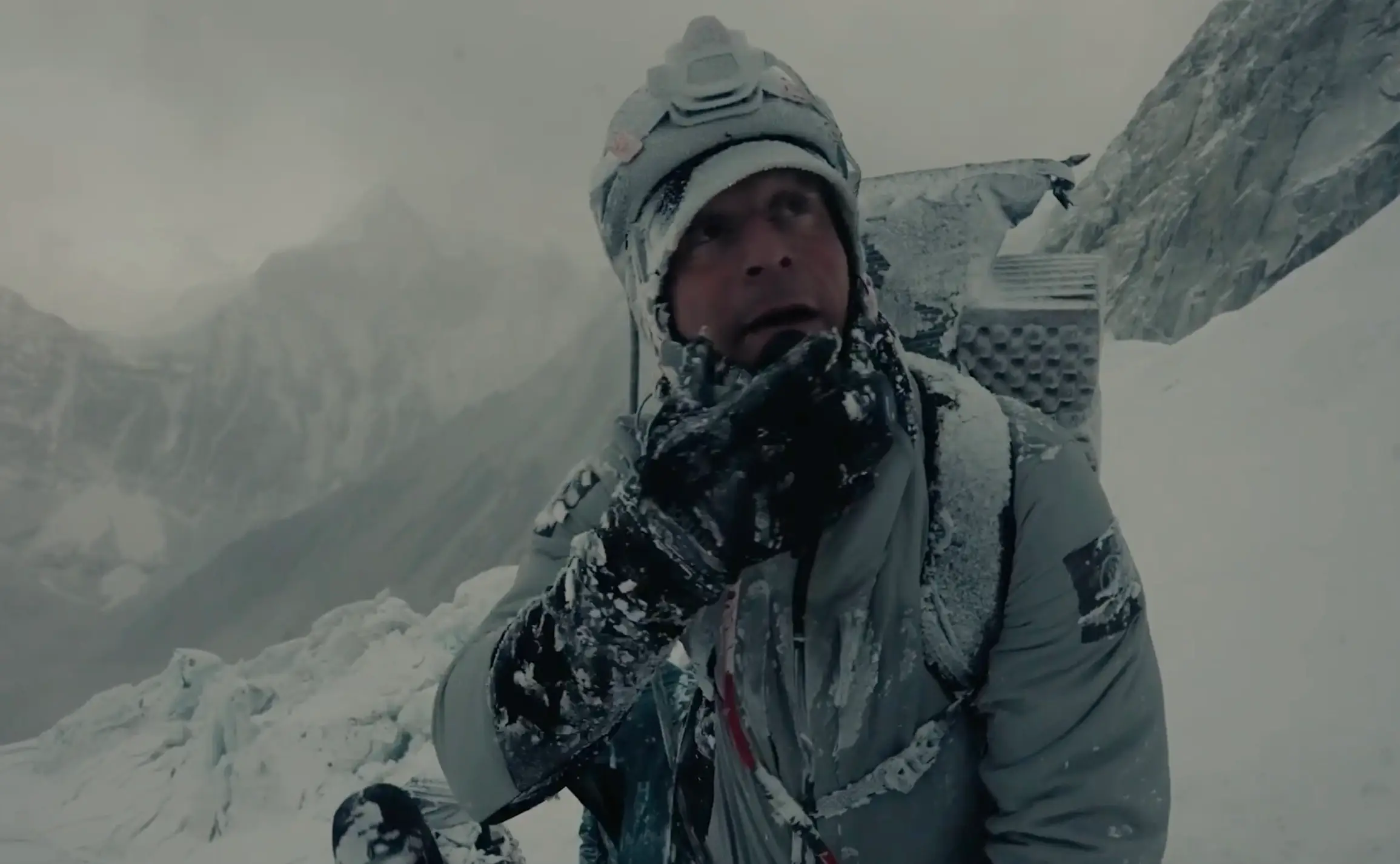
The lads couldn't exactly afford to take a beat anyway, as they were on a mission to set a new world record by getting from London to Nepal, reaching the summit of Everest, and heading back home again in just seven days.
Scaling Everest at breakneck speed isn't for the fainthearted, though, as Staz told LADbible that the mentally and physically exhausting expedition could easily cost you your life.
This sunk in for the former SAS: Who Dares Wins star as he traversed the fearsome Khumbu Icefall, a tricky stretch situated just above Base Camp that has been the site of dozens of fatalities.
In Staz's words, the shifting glacier is 'very, very dangerous' - which is probably saying a lot, coming from a former chief sniper instructor and demolitions expert, who served in the SAS for a decade.
The father-of-three told LADbible: "Just shy of Camp One, maybe a couple of hours out from there, we got hit by a f***ing avalanche. Not ideal."
And thanks to the group's cameraman, Sandro, this heart-stopping moment was captured on film.
Take a look at the extraordinary footage here:
The military men were attached to a fixed line when they first began to sense the snow slipping, meaning that even if they wanted to run for their lives, they couldn't go anywhere in a rush.
"We just hear a huge crack to our left - and we can hear them happening around the mountain - but we heard this huge crack," Staz said. "And we're like, 'F**k'. We looked up, and there it was.
"Right in our path, this huge avalanche just sliding down the mountain towards us.
"And at that point, you do the obvious - look the other way. Where can I run? I can't run. There's a big crevasse, I'm attached to the line and it's going to hit us in about 20 seconds.
"So we have to take a knee and try and brace onto the rope."
.In footage shot moments after the avalanche hit, in true SAS-style, Staz told the camera: "We managed to get caught up in a small avalanche.
"Thankfully, it just passed straight through us and over us - covered us - but yeah, we're quite lucky. Live to fight another day. Fortune favours the brave."
Staz and his elite SAS squad summited Mount Everest on the morning of 21 May before landing back in London on 23 May.
They reached the peak of the nearly 30,000ft mountain in just four days and 18 hours, about seven weeks faster than the average climber.
The incredible feat was down to months of relentless training, endless nights of kipping in a hypoxic tent, and a quick trip to Germany to inhale some Xenon gas, which meant they were tailored to the altitude before they even arrived.


0 commentaires:
Enregistrer un commentaire